
In modern water treatment, disinfection is essential for protecting system integrity and public health. However, when water contains natural organic matter (NOM), disinfection can introduce another challenge—the formation of TOX (Total Organic Halides). These compounds form when oxidizing disinfectants, particularly chlorine-based chemicals, react with organic material in the water.
For organizations relying on water treatment services in UAE, understanding how different disinfectants influence TOX formation is critical. Two widely used oxidants in industrial and municipal applications are sodium hypochlorite (NaOCl) and chlorine dioxide (ClO₂). Although both are effective, their reactions with organic matter differ significantly. At Hydroguard, disinfectant selection is guided by both performance and by-product control.
How Sodium Hypochlorite Contributes to TOX and THM Formation
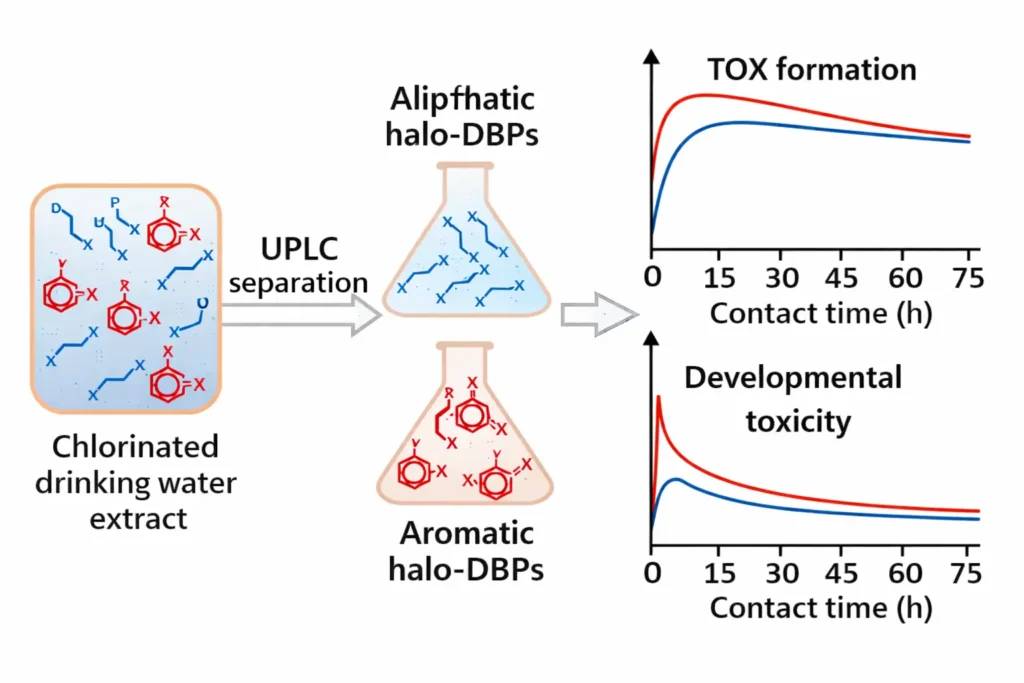
Sodium hypochlorite disinfects by releasing free chlorine, which readily reacts with organic compounds present in water. During this process, chlorine substitutes hydrogen atoms in organic molecules, forming halogenated by-products. The most well-known group of these by-products is trihalomethanes (THMs).
Common THMs formed include chloroform, dichlorobromomethane, chlorodibromomethane, and bromoform. These compounds are regulated in drinking water treatment UAE systems due to their potential health and environmental risks. Higher levels of NOM, warmer temperatures, and extended contact time all accelerate THM and TOX formation.
For this reason, facilities working with water purification services UAE must carefully evaluate hypochlorite use in organic-rich water sources.
Why Sodium Hypochlorite Produces Higher TOX Levels
The chemistry behind hypochlorite-driven TOX formation is well established. Chlorine acts as a strong electrophilic halogenator. When it encounters natural organics, halogen atoms integrate directly into the carbon structure of organic molecules. This reaction pathway generates a broad range of halogenated organic compounds, all of which contribute to overall TOX values.
As a result, sodium hypochlorite disinfection can lead to elevated TOX levels, increased THM concentrations, and a higher load of oxidation by-products. These by-products may also affect downstream equipment and treatment processes. Through experience in industrial water treatment services UAE, Hydroguard often addresses these challenges by reassessing oxidant selection.
Chlorine Dioxide: A Low-TOX Alternative
Chlorine dioxide behaves very differently when it reacts with organic matter. Instead of halogenating organic molecules, ClO₂ disinfects primarily through electron transfer oxidation. This means it alters organic compounds without adding chlorine atoms to their molecular structure.
Because chlorination does not occur, chlorine dioxide produces minimal TOX and virtually no THMs. Even in water with high organic content, by-product formation remains extremely low. For systems where by-product control is critical, this difference is significant.
Why Chlorine Dioxide Minimizes TOX and THMs
Chlorine dioxide does not chlorinate organic molecules, which prevents halogenated by-product formation. It oxidizes organics selectively, producing fewer secondary compounds. As a result, THM formation is negligible, and overall TOX levels remain low.
These characteristics make chlorine dioxide particularly effective for cooling towers with organic contamination, industrial process water containing hydrocarbons, potable water systems requiring strict THM control, and wastewater polishing applications. Based on project-specific requirements, Hydroguard frequently recommends ClO₂ as part of advanced water treatment services in UAE.
Choosing the Right Disinfectant for Safer Water Treatment
Disinfectant selection should balance microbial control with chemical by-product management. While sodium hypochlorite remains effective and widely used, its tendency to form TOX and THMs makes it less suitable for certain applications. Chlorine dioxide offers targeted disinfection with significantly reduced by-product risk.
By understanding these chemical differences, operators can make informed decisions that protect water quality, equipment, and compliance. Through technical expertise and application-specific evaluation, Hydroguard supports facilities in selecting the most effective and responsible disinfection strategies. For organizations seeking advanced water treatment services in UAE, this knowledge-driven approach ensures safer outcomes and long-term system reliability.