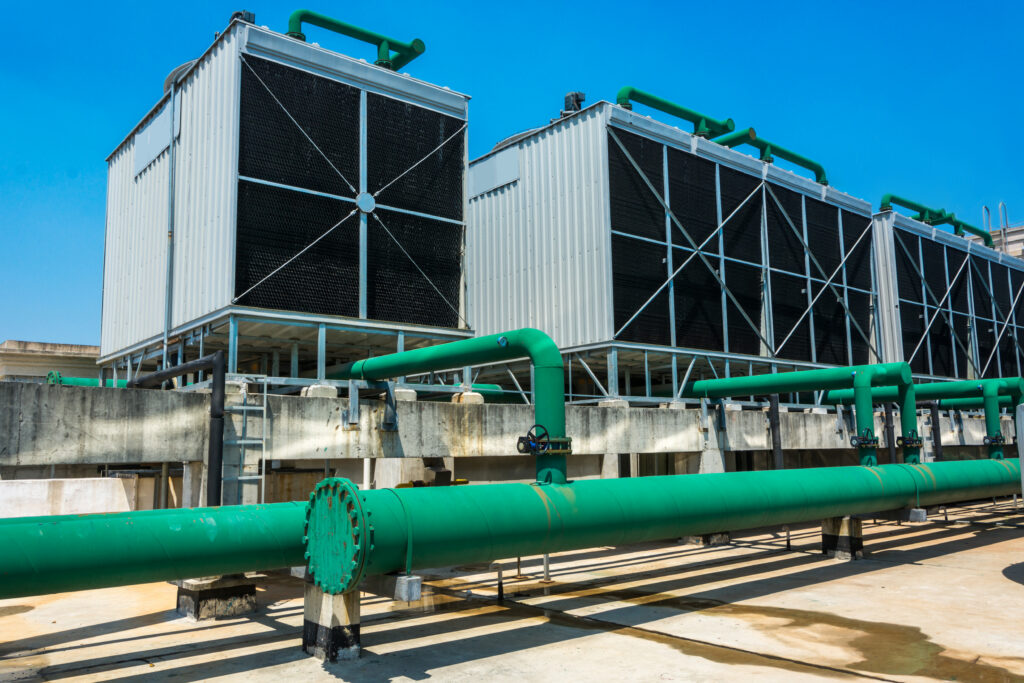
Your cooling tower is running, but something has changed. The basin needs cleaning more often. White deposits are appearing around the spray nozzles. Cooling temperatures are becoming harder to maintain.
These changes deserve attention before they become recurring maintenance problems. For facility and plant managers, recognising cooling tower water treatment signs early can help protect equipment, maintain cooling performance, and plan corrective work.
Cooling towers need continuous water quality management. As water evaporates, dissolved minerals become more concentrated, while airborne particles can enter the system. Without effective treatment and maintenance, these conditions can contribute to scale, corrosion, and fouling.
Here are ten warning signs that your cooling tower’s water treatment programme needs a closer look.
1. White or Chalky Deposits Are Appearing
White, crusty deposits around nozzles, fill, or other wetted surfaces may indicate mineral scale.
As cooling water evaporates, minerals remain in the circulating water. Depending on their concentration, temperature, and water chemistry, some can form hard deposits. These deposits can obstruct water distribution and interfere with heat transfer.
If you notice scaling, review makeup water quality, conductivity trends, blowdown operation, and scale inhibitor control. Deposit analysis can help establish what has formed and how to remove it appropriately.
2. Metal Components Show Rust or Pitting
Rust stains, flaking surfaces, and small pits in metal components can indicate corrosion. Affected areas may include the basin, pipework, fasteners, and structural supports.
Cooling tower scale and corrosion require different investigations. While scale involves material building up on surfaces, corrosion involves deterioration of the metal itself.
Arrange an inspection to establish the extent of damage and review the corrosion control programme. Structural deterioration also requires assessment and repair by appropriately qualified personnel.
3. Slime or Algae Is Visible
Slippery surfaces and green growth are common signs of biofouling. Biological material may collect on fill, inside the basin, or in areas with limited circulation.
Visible growth should prompt a review of dosing equipment, biological control, cleaning, and circulation. Biofilm can also develop in less accessible parts of the system.
Appearance alone cannot establish microbiological safety. Monitoring and testing should follow the facility’s water management programme, including its measures for controlling Legionella risk.
4. Dirt and Sludge Collect in the Basin
A growing layer of sediment suggests that the system is accumulating solids.
Cooling towers draw in air and can collect dust and other airborne particles. These materials can settle in the basin or circulate through the system, contributing to cooling tower fouling.
Inspect basin cleanliness, strainers, and existing filtration arrangements. For towers exposed to dusty conditions, suitable side-stream filtration may help manage suspended solids alongside routine cleaning.
5. Nozzles and Strainers Keep Blocking
Repeated blockages indicate that an ongoing source of debris or deposits needs investigation.
Cleaning a blocked nozzle may restore water distribution temporarily. If the blockage returns, inspect the removed material and check the surrounding system for scale, corrosion products, biological growth, or incoming debris.
Maintenance records can help reveal whether blockages occur after particular operating changes or increase between scheduled cleaning visits.
6. Cooling Performance Is Declining
A tower that struggles to maintain its usual leaving water temperature needs assessment.
Compare performance under similar heat loads and entering-air wet-bulb conditions. Outdoor conditions affect cooling tower performance, so a temperature increase needs to be considered alongside weather and operational data.
Inspect fans, airflow, water distribution, and water flow as well as deposits on wetted surfaces. This helps identify whether water treatment issues are contributing to the change.
7. Energy Consumption Has Increased
An unexplained rise in cooling-system energy use can justify a water-side inspection.
Deposits can interfere with heat transfer in connected condensers and heat exchangers. However, changes in cooling demand, operating hours, and equipment condition can also affect consumption.
Review energy trends alongside system load and maintenance records. A combined mechanical and water treatment assessment provides a clearer basis for corrective action.
8. Conductivity Readings Are Unstable
Conductivity helps track the concentration of dissolved minerals in circulating cooling water.
Frequent alarms or readings outside the programme’s operating range may indicate problems with blowdown control, makeup water, or monitoring equipment.
Check probe cleanliness and calibration, controller settings, and blowdown valve operation. The appropriate conductivity range depends on the site’s water chemistry and treatment programme.
9. Water Consumption Is Rising
If makeup water consumption increases without a corresponding change in cooling demand, investigate the cause.
Leaks, overflow, excessive blowdown, and operating changes are possible explanations. Compare meter readings with previous performance and inspect water control equipment.
Managing cycles of concentration appropriately can reduce water consumption. The operating range must also support control of scale, corrosion, and biological growth.
10. Water Tests Repeatedly Miss Control Limits
Some of the earliest warning signs appear in test results.
Recurring deviations in pH, conductivity, inhibitor levels, or microbiological monitoring suggest that treatment control needs attention. Review the pattern, identify the cause, and document corrective action.
Follow-up testing should confirm whether the action restored control. Keeping consistent records helps facility teams identify recurring problems and assess treatment performance over time.
What Should You Do When These Signs Appear?
Start by collecting recent water analysis, chemical dosing records, cleaning reports, and operating data. Record when the symptoms began and whether they followed a shutdown, maintenance visit, or change in water supply.
A cooling tower assessment should review:
- Makeup and circulating water quality.
- Chemical dosing equipment and treatment control.
- Conductivity monitoring and blowdown operation.
- Basin, fill, nozzle, and strainer condition.
- Water circulation and mechanical performance.
The findings may point to cleaning, equipment repairs, revised monitoring, or adjustments to the treatment programme. Chemical selection and dosing should reflect the actual water quality and operating conditions.
For teams planning cooling tower maintenance in the UAE, combining these checks with routine inspections helps address developing problems earlier.
Cooling Tower Water Treatment Support from HydroGuard
HydroGuard supplies cooling water treatment chemicals and provides water testing and technical support for industrial and commercial facilities across the UAE.
If your cooling tower shows recurring deposits, corrosion, biological growth, or unstable test results, our team can help assess your treatment requirements.
Share your system details, operating concerns, and recent water analysis to discuss a treatment programme suited to your facility